
KEY TAKEAWAYS: The board discussed the proposed policy on bullying which would allow administrators to wait two days before informing parents that their child was bullied at school. The disorganized process being used to revise policies continues to cause problems and Austin announced that she will change the process and is considering restarting the policy committee that she had disbanded. Three community members complained to the board that Mumford posted a public election document online. Mumford agreed to meet with the school attorney to defend herself against claims from Austin and Witt that she violated board policy. Austin discussed plans to call for a vote to formally censure Mumford. A much improved version of the policy on recordings at school was approved. It is unclear who will pay the increased taxes and how much additional revenue will be raised if the school issues the proposed general obligation bond. The city has agreed to help fund the tennis court replacement project and pickleball striping will be added to the courts.
Agenda with links to board documents
TOPIC TIMESTAMPS (Youtube Recording Link)
- 0:44 Discussion on policy G350 on recording
- 7:21 Discussion on policy C200 on bullying
- 13:06 Proposal to require parent notification of bullying by the end of the day
- 24:59 Austin refuses to share proposed revisions
- 37:06 Witt recommends restarting the policy committee
- 41:36 Community comment on the policy revision process
- 59:44 WLES student recognitions and school report
- 1:26:45 Mental health therapist report
- 1:38:26 Communication from the audience
- 1:40:44 Point of order on communication from the audience
- 1:53:38 Request that Mumford meet with the school attorney
- 2:10:54 The revised version of policy G350 on recording is approved
- 2:16:52 Policies C200, A125, A200, A225, and B100 are all quickly tabled. Policies A175, A250, and A350 are approved.
- 2:35:00 Seeking broad feedback for the strategic plan
- 2:45:52 Budget for 2025
- 3:12:33 Proposal to issue a general obligation bond and a discussion of who would pay the increased taxes
- 3:50:24 New tennis courts will have pickleball striping
- 3:53:56 Board reports
The following is my summary of the public school board meeting, not the official meeting minutes. My personal thoughts and opinions are given in italics and represent my own views which do not necessarily reflect those of any other member of the school board. I identify myself as Mumford in the summary but use first person when describing my personal thoughts and opinions.
The board held a public work session from 5-6pm.
0:44 Austin announced that for our work session we will discuss proposed policies in the order she listed them on the regular meeting agenda. First is proposed policy G350 on recordings (original version, final revised version). Wang verified that the revised version requests notifying the school 24 hours prior to recording. Yin said that her colleagues who work in special education expressed a concern about meetings where other students’ names may be mentioned and asked if the policy should include something about protecting other students’ privacy. Austin said that administrators could refer to other students by their initials and that this could be an administrative guideline. Greiner said that parents may still refer to other students by name and that administrators cannot tell parents what to say or not say in a meeting.
7:21 Next is proposed policy C200 on bullying (original version, revised version). Austin said that Wang recently suggested additional revisions and said that she is not going to allow them to be considered because our legal counsel, Church Church Hittle and Antrim (CCHA), said that we should not make any adjustments to this policy because bullying is an area of significant legal exposure. Mumford said that the board already discussed several proposed revisions prior to Wang’s recent proposal and CCHA had recommended making some of those changes. Austin disagreed and read an email from CCHA regarding a proposed addition to the definition of bullying (which was discussed at the August Meeting at 42:10): “I would not recommend the Board adopt the additional language regarding bullying. First, the language goes beyond the legal definition of bullying. If the General Assembly wanted schools to address one-time severe incidents with the potential to be repeated as bullying, it would have revised the law. Second, it will be difficult, practically, to implement such language.” Austin said that it is pretty clear from legal counsel that they don’t want us to “fool around” with this policy. Mumford clarified that this was CCHA’s response to just one of the proposed revisions and does not mean they are recommending no changes to the entire policy. Mumford noted that CCHA was in favor of the proposed revision on page 2 to include kindergarten. CCHA said that since this is our current practice that the policy could be changed to reflect this. Austin asked Greiner why this was written with just grades 1-12 and Greiner said that doing this program for grades 1-12 is what is required by law. He said that the administration wants the policy to be consistent with the law and acknowledged that our current practice is to include kindergarten in the anti-bullying program. Mumford said that our policy should match our practice. School policies are not just copying and pasting state law. Our policies should comply with state law and describe how it is applied in our district. Austin said she will have the board vote on the original CCHA-written policy, not the revised version, and only if that doesn’t pass would we vote on any proposed revisions.
13:06 Mumford noted that there are additional proposed revisions, including an important one in the parent involvement section. The original CCHA-written policy says: “Parent notifications will occur in an expedited manner within two school days after the designated school administrator receives the report of suspected bullying.” Mumford said that the proposed revision would require school administrators to inform parents by the end of the day in which the report is received. Austin claimed that two days is what is required by law. Mumford replied that Indiana law gives administrators up to five days. Austin said that two days then seems like a healthy compromise and that administrators would strive to exceed that whenever it is possible. Austin said that requiring same-day parent notification could be detrimental, particularly if the incident occurs at the end of the school day. Witt said that we could include the wording “as soon as is reasonably practical, no greater than two days.” Austin asked Greiner for his recommendation. Greiner said that he recommends passing the original policy as written by CCHA without any changes. Witt said that she supports his recommendation.
Austin said that the administration is speaking clearly and so is our legal counsel. Mumford shared her view that our school policies should include input from legal counsel and our administrators, but then the board also gives input. She said that as a parent she is very uncomfortable with this particular part of the policy. If a child is bullied at school, comes home and then goes back to school the next day without the parent even knowing about the bullying, this is a problem. Mumford said that it is concerning that parents are not being alerted to the bullying and that children are going back into that serious situation without their parents being able to help them. Witt pointed out that there are false complaints and that if an administrator shares information with a parent before they have all the information then that could create a difficult situation. Witt said that the information shared has to be complete and truthful. Austin said she agrees. Wang disagreed and said that parents should be informed as soon as possible.
When parents are informed is very important to me. Administrators do not need to have concluded their investigation before telling a parent that their child may have been bullied at school. Administrators can tell parents that the situation could potentially be bullying and that administrators are working to investigate and find out all information. Think about it from the child’s point of view. If a child feels that they are being bullied at school or being accused of bullying, they are dealing with some strong feelings. For a variety of reasons, children do not always tell their parents what they are dealing with at school. For the school to not tell parents for up to two days means that children are going back into that situation at school without having received support at home from the parents. From the parent’s point of view, when administrators choose to not inform them about the bullying concerns they are cutting parents out and not allowing them to help their child know how to handle and respond to the situation. My view is that parents need to be notified that same day if there is a bullying situation that involves their child. The 2023 December Meeting (27:16) included a presentation on bullying in our schools with a discussion of the current practices for parent notification.
Austin said she feels confident that we are ready to vote on the original version of C200. Mumford reminded her that there are several additional proposed revisions that have not been discussed. The next proposed revision is to add a requirement that parents be provided with “regular updates on the progress and the findings of the investigation and of any remedial action that has been taken.” She noted that CCHA had no issues with the change to require regular updates on the progress and findings but they recommended not including updates on remedial actions as this could infringe on privacy rights. Mumford said that striking that final part of the revision makes sense, but said that it is important to include in the policy that parents should receive ongoing updates. Austin thanked Mumford for her opinion. Yin said she would also like parents to be notified as soon as possible, certainly within 24 hours. Even if the investigation isn’t complete, parents should be given preliminary notice that there is an investigation.
Yin referenced a community member that spoke at a school board meeting about a discrepancy between bullying in our schools and what we report to the state (January Meeting at 46:56). She asked who decides if a situation is bullying that needs to be reported. Greiner said that if the investigation concludes that it is bullying then it is documented on skyward which is how the numbers are collected to send to the state. Austin asked Greiner if this can be determined within the first few hours after an incident or does it take time. Greiner said there is a process and they have to complete documentation.
Wang said that he emailed the board two proposed revisions well in advance of the meeting and asked Austin if she is still following the procedure of having proposed revisions added to the documents in the school board packet and then allowing a discussion of the proposed revision. Austin said that we are following that procedure. Wang’s proposed revisions were not included in the board packet. Wang said that the first proposed revision is under the investigation section where he would like to add that “the School Corporation shall document acts of bullying and abusive behaviors which are against a victim and committed by a verified perpetrator” as required by Indiana code 20-33-8-35. Austin said thanks to Wang and then said that we should move on. Wang said that his other recommended revision is in the education section: “the Corporation shall maintain a link on its internet website to the internet website resource page maintained by the Indiana Department of Education that provides parents and school officials with resources or best practices regarding the prevention and reporting of bullying and cyberbullying” in accordance with Indiana Code 20-19-3-11.5.
24:59 Austin said: “Going forward here is what we are going to do. We’re going to email the entire board our suggestions. We are going to send them to the lawyer and our administration. If our lawyer and our administration says that is a terrible idea, we are going to stop there. That’s going to be the end of that conversation because we hired them to give us legal advice. These suggestions [Wang is] making are both things to which the lawyer said no thank you. That is why they do not appear in the folder. Only at the point where a policy suggestion has passed through those two gates will it be in the folder for us to consider voting for.” Witt told Austin that she respectfully disagrees. Legal counsel gives advice but we are not required to comply. Once all board members have all information necessary to vote, then a vote can take place. Austin defended her position by saying that our legal counsel has been flexible on many things in the process, “but on this particular policy, they’ve been extremely clear this is going to open up a lot of liability if we fool around with it or add a lot of extra things from the law or change definitions and that could lead to future legal action in a way that is against what we’re supposed to be doing which is preventing liability for the school.” Austin is making inaccurate statements. At the August Meeting (42:10) she asked our attorney specifically if the proposed addition to the definition of bullying would open us up to liability and the attorney answered clearly that it would not increase potential liability for the school corporation. The attorney was asked the same question again and gave the same answer that the proposed change to the bullying policy does not increase liability.
Witt replied to Austin: “the authority still resides with the board; the authority does not reside with the attorney.” Austin said that if we were to have multiple substantive disagreements with our legal counsel then we would seek new counsel, but CCHA has not demonstrated that they are out of alignment with our community’s values. Witt said: “It is important to keep a clear delineation that the members of the board ultimately are voting to enact policies on the recommendation of legal counsel. If board members do not care for the recommendation of legal counsel, they can vote against the policy.” Austin said that if the policy as written by CCHA does not get a majority vote, only then will she take it back to CCHA and ask them to revise it. Austin claimed that Wang’s proposal to add pieces of Indiana code to our policy is not aligning it with our community specific values. It appears from the January Meeting (46:56) that our district has not always correctly documented bullying. Wang’s request is not arbitrary; he appears to be trying to get the administration to prioritize addressing this issue.
Mumford said that Austin should not limit what information is shared with the public and what is discussed as a board. She said that Wang sent his proposed revisions by email ahead of time, as requested. Those revisions went to our legal counsel and they gave their opinion and then Wang asked for the revisions to be included in the board packet. Austin said that our legal counsel said that those revisions are not necessary and so she decided not to include them in the board packet. Mumford said that Austin does not have the authority to exclude Wang’s proposed revisions from the board packet. In response Austin gave an example saying, suppose that Wang wanted to smoke cigarettes and legal counsel told him no it was a bad idea and he will probably die, but then Wang said he wants to smoke cigars and legal counsel said no it’s a bad idea and he will probably die, and then administrators said the same thing and then Wang asked about cloves and all responded no, it’s a bad idea. Austin said that is what the email exchange with Wang was like. She repeated her claim that our legal counsel believes this particular policy is dangerous to “fool around with.” Austin continued: “I mean the policies don’t say don’t murder anyone either, but we’re not going to do that . . . I don’t feel like it’s necessary to spell out we’re going to follow this code and this code and this code if doing so is going to open us up to legal liability.” Austin said that she is only going to allow a vote on the original version and said that in her opinion, no one has come up with any revisions that would increase safety for the district or for the students. She concluded by again claiming that legal counsel told us to leave this policy alone. There was no email back and forth about Wang’s proposed revisions besides Wang’s request to add it to the board packet. Our legal counsel never said the things that Austin is claiming they said. Austin does not have the authority to unilaterally decide that a proposed revision is not allowed to be considered by the board.
37:06 Witt shared how policy revisions were done previously. She said they were discussed by the policy committee and there were various options. The policy committee would determine their recommendation and then send all of the information to the entire board for the board to determine if they agree. Witt said that the process Austin is using is inefficient and that the current conversation is not fruitful. She recommended a format where there are various options for each section and noted that we have to follow Indiana’s Open Door Law. Austin asked if anyone would like to volunteer to serve on the policy committee. Wang, Witt, and Mumford said they would serve on the committee. Witt said there are scheduling challenges to be aware of. Austin said, “I feel like the chaos is being done deliberately. The process is being slowed down deliberately for political ends.” Austin said that part of her wants to go back to just using our old policies. She said she would accept nominations for the policy committee during the meeting. (Note that Austin did not ask for nominations for the policy committee during the regular meeting. Policy C200 on bullying was briefly discussed during the regular meeting at 2:16:52 with no vote taken.) It was Austin who shut down the policy committee when she became board president. Austin could have used a collaborative approach, but instead has taken an increasingly authoritarian approach in her board leadership. Repeating over and over the false claim that our legal counsel advised us to not fool around with this policy does not make it true.
41:36 Austin decided to end the work session early and asked if there was any public comment.
- Maria Koliantz (parent and current school board candidate) said that other boards she has served on as well as her church use Robert’s Rules of Order and recommended that when a policy is discussed and someone recommends an amendment that there is a vote on just that one amendment. For example, if you are discussing policy A then you vote on amendment A1. Then if there is another amendment then it would also be numbered and there would be a vote on that proposed change. She said that the main points should be worked through during work sessions. I agree with Koliantz’s recommendations. Each proposed revision needs to be labeled and addressed separately. One of the biggest issues with the policy revision process all year has been the total lack of organization. I maintain a list of all the proposed policies with revisions on my website.
Regular Board Meeting
59:44 The regular board meeting began with Sara Delaney (WLES Principal) who recognized students who were in the Good Citizenship Club for the life skill of friendship. Two students from each grade (kindergarten – third grade) were recognized and honored. We have wonderful students and families in our school district! I appreciate the administration and teachers for recognizing them.
1:09:50 Delaney shared a slide presentation with some information about the elementary school. Currently they have 11 preschool students and 656 students in kindergarten – third grade with 47 teachers and 40 support staff. 25.8% students qualify for free/reduced lunch and 12% are in special education, which includes students receiving speech and language only. She said they are waiting to hear if WLES will be selected as a 2024 National Blue Ribbon School. (Update: It was announced on 9/23/24 that WLES was one of sixteen schools in Indiana to be named a National Blue Ribbon School by the US Department of Education. Congratulations WLES!)
Delaney shared data from our third grade state testing. IREAD 3 test scores dropped a bit from a 92.4% pass rate in 2022-2023 to 91.3% in 2023-2024. ILEARN Math had a 78.1% pass rate in 2022-2023 and 78.0% in 2023-2024. ILEARN ELA (English Language Arts) increased from a 63.9% pass rate in 2022-2023 to 73% in 2023-2024. Delaney said that they have set goals for their school improvement plan to increase test scores. Second graders now take the IREAD exam and if they pass they don’t have to take it in third grade. Currently just 64 third graders will have to take IREAD in the spring. There are interventions in place for students who scored at-risk in second grade. WLES has opted into three ILEARN Math checkpoints through the year that are used with curriculum mapping and planning. The first checkpoint will be in early October. For ILEARN ELA their goals are focused on the writing portion that includes narrative and informative writing. One issue has been that students usually write on paper for assignments, but then for the state test they have to type their answers using a device. Delaney said that they are focused on increasing student experience typing in all grades at WLES. They are also focusing this year on narrative writing. A group of teachers used the ILEARN third grade rubric and created rubrics for kindergarten-second grade. The WLES mission statement is repeated daily and says “Together, we create a safe, supportive, and equitable foundation where ALL reach their highest potential.”
1:26:45 Alyson Smith, WLCSC mental health therapist, shared an update. September is Suicide Prevention month which provides a time to remember those who have lost their lives to suicide and also to bring awareness of warning signs, prevention, and intervention. Our schools received a two-year grant for preventing youth suicide which is a partnership with North Central Health Services and the Education Development Center. Smith attended the Tippecanoe County mental health roundtable meeting where mental health providers from across the county described the different services that they offer. This included individual mental health therapists as well as other organizations like Food Finders, Pride Lafayette, and the Red Cross. It was helpful to make those connections and discuss ways that they could help the schools.
Smith shared that she is continuing to work with a few students that had been meeting with her at the end of the last school year and she has received 15 new referrals this school year. At WLES they have started classroom guidance lessons to identify feelings and zones of regulation and to introduce some brain science. At WLIS they have also started classroom guidance lessons about belonging and anti-bullying and the counselor has several lunch groups. A JSHS club, Bring Change to Mind (BC2M) is about destigmatizing mental health treatment and they are working to make this club available to sixth graders as well. At the JSHS, four additional staff have been trained in Question Persuade Respond, a suicide prevention intervention. They are also collaborating with Calla Collaborative Health to provide free small group sessions for juniors and seniors on time management, self-care, making smart decisions about drugs and alcohol, relationships and boundaries, and more. The BC2M club is collaborating with the new Purdue Cares hub. Purdue athletes speak to students about maintaining physical and mental health.
1:38:26 Communication from the audience (those who had signed up before the meeting began):
- Amy Masson (resident) complained that on September 7, Mumford shared an election board document online that contained names, addresses, birthdates, and signatures of those who signed the school board candidate petitions including her and other members of her family without their knowledge or consent. Masson said that Mumford claimed her purpose was transparency, but Masson said that this was doxing, searching for and sharing private and identifying information on the internet without the individual’s consent. Just because it is legal, doesn’t mean it is alright to do. She said she publishes websites and that she always tells her clients to get consent before publishing any information. Masson said that it doesn’t bother her that people know that she signed certain candidates’ petitions. She believes in the democratic process and would have signed all 6 school board candidates’ petitions. Masson concluded by telling Mumford that if she chooses to publish her name on Mumford’s website, that she is doing it without her consent. Masson built the campaign websites for Austin, Lyle, and Koliantz. Masson is also Austin’s co-author of a book of alcoholic drink recipes.
I wish I had thought to redact the personal information before posting the candidate petitions online and I apologize for not having done that. Soon after posting the documents, I received a private message asking me to black out the birthdates and addresses and so I immediately replaced the documents on my google drive with new versions where the birthdates and the addresses are redacted. The next day I received a message asking me to also remove the signatures, so that day I replaced all the documents with new versions where the signatures are also removed. My only desire was to share publicly available campaign information before the school board election, certainly not to dox anyone. These are public documents that anyone can request from the election board and are intended for public release. I think it is very important that campaign information be publicly available. The only information about a school board campaign that the public are allowed to see are the names of those who signed a candidate’s petition form, the names of those who make large donations to a candidate, and a list of the candidate’s election campaign expenditures. For those that want more details, I created a timeline of when I posted and redacted the documents.
This is the list of who signed each candidate’s petition:
Amy Austin: Karen Adams, Brad Marley, Alan Karpick, Benjamin Austin, George Lyle, Harper Masson, Mary Austin, Shawn Greiner, Doug Masson, Eric Maloney, Matt Morgan, Soo Strahinich, Steven Strahinich, Amy Masson, Lincoln Masson, Gale Charlotte
Maria Koliantz: Ara Koliantz, Amy Austin, Mary Austin, Amy Masson, Harper Masson, Lauren Alexander, Brian Russell, Laura Russell, James Jenkins, Rainey Jenkins, Leanna Giltmier, Brett Giltmier, Randall Wood, Kimberly Wood
George Lyle: Lincoln Masson, Harper Masson, Doug Masson, Amy Masson, Amy Austin, Gale Turco, Ronald Turco, Donna Rayman, Paul Rayman, Brandt Patz, Emily Kinsell, Jamie Richards, LaDawn Lyle, George Lyle, Rachel Witt
David Purpura: Ashley Purpura, Susan Clampitt, Brendan Cavanaugh, Cathay Cavanaugh, Jacob Ricker-Gilbert, Kim Stern, Alan Karpick, Amy Karpick, Tanya Finkbiner, David Purpura
James Beau Scott: David Wegiel, Sharon Smith, Mindy Mallory, Jianping Landrum, Alex Quinn, Aliya Scott, Sofya Zemlyanova, Graciela Takayama, Ryan Sherman, Kristie Sherman, Patrick Brunese
Yue Yin: Linda Nie, Ningning Kong, Songlin Fei, Zhenyu Qian, Li Li, Ping Xu, Lan Chen, Qiang Lui, Xiaomin Qian, Jian Jin, Dengfeng Sun, Yanrong Wu, Wenbin Yu, Mingbo Li, JianJie Huang, Qing Jiang, Yu Qiu, Ninghui Li
1:40:44 Mumford made a Point of Order. She said that our board policy states that comments from the audience must be about school programs, policies, or procedures and that it is the responsibility of the board president to ensure that comments from the audience follow this policy. She asked Austin how she is going to handle this? Austin responded, “if you do not want to hear such comments then you should not act in a way that brings that sort of criticism upon yourself.” Mumford read the policy again and said that Masson’s comment had nothing to do with school programs, policies, or procedures. Austin responded, “duly noted” and called on the next person to share public comment.
Policy 0167.3 on Public Participation at Board Meetings states: “The presiding officer shall be guided by the following rules: #5 – All statements shall be directed to the presiding officer; no person may address or question Board members individually. Comments must be about programs, policies or procedures. Comments about building staff and/or children other than the speaker’s child(ren) shall not be heard in public session.”
- Doug Masson (former school board member) said he is speaking because Mumford doxed community members by posting candidate petitions that contained signatures, addresses, and birthdates with no regard for whether sharing the information served any useful purpose. He said that these documents were posted to a Facebook forum that is not moderated and complained about some of the comments made on this forum by other people months earlier. Masson said that at last month’s meeting, a community member, Don Coller, criticized Mumford’s summaries as unprofessional and that Mumford’s response in her summary was disingenuous, dismissing the criticism because it was coming from a neighbor of Austin’s (August Meeting, 1:07:08). Masson said that he expects his criticism of Mumford to also be dismissed by her because he was supported by the PAC. As he went to sit down Austin asked Masson to explain his relationship to our school district policies. Masson said that he served on the policy committee and that he reviewed piles of school policies during his time on that committee. Masson was appointed to the school board in 2015. He was supported by the PAC in the 2016 and 2020 school board elections, but did not win a seat on the board either time. He served on the policy committee during his time on the school board and continued on the policy committee as a community member after losing his seat in the 2016 election (January 2021, see question 2).
- Annie Dooley (WLIS 5th grade teacher, HS assistant softball and soccer coach) said that our school district offers incredible education and extracurricular opportunities. She has worked in two states and in three school corporations and believes that the teacher evaluation process here gives her the best and most useful feedback. Our teachers are evaluated by building administrators. As a teacher, Dooley accepts student and parent feedback, but she does not want student or parent feedback included in the formal evaluation which has influence on her salary, teacher appreciation grant funding, and potentially her employment.
- Gale Charlotte (former school board member) said that Mumford should not have shared the school board candidate petitions and said that the most egregious of the information posted was her signature. Charlotte said that she is furious about this and she does not care what Mumford’s motives were. She said that Mumford has been asked repeatedly over the last two years to stop posting her school board meeting summaries but Mumford continues to write these summaries anyway. Charlotte said that although anyone can request the candidate petitions from the election board, Indiana code requires that the documents only be used for political purposes and she said that Mumford has stretched the permissible use right up to the line. Charlotte concluded: “forcefully tonight I request two things. Number one, a public apology from Mrs. Mumford here tonight and also on the Facebook Open Forum. Number two I’m asking the board to offer up a censure resolution drafted by the board and voted on at the next public meeting.” Two days before the meeting I had already posted a public apology on Facebook. I also made a public apology later in this school board meeting once I was allowed to speak. I am sorry that I didn’t think to redact the birthdates, addresses, and signatures from these public documents before posting. I agree that it is really only the names of those who signed each candidate petition that is important to voters in this election. All three people who complained about me posting the candidate petitions had signed Austin’s form.
1:52:40 The board was asked to approve the consent agenda items:
Agenda for the September 16, 2024 Regular Meetingof the Board of School Trustees- Minutes of the August 12, 2024 Work Session of the Board of School Trustees
- Minutes of the August 12, 2024 Regular Meeting of the Board of School Trustees
- Minutes of the August 26, 2024 Work Session of the Board of School Trustees
- Minutes of the September 10, 2024 Executive Session of the Board of School Trustees
- Personnel Report
- Accounts Payable WLCSC, Accounts Payable WVEC, Payroll Claims Docket
Witt motioned to move the agenda off the consent agenda items so that she could add an item. Wang seconded it. The consent agenda was voted on without approval of the agenda.
Voted 7 out of 7
1:53:38 Witt said that she has heard from community members who have expressed concerns about Mumford’s school board meeting summaries and social media posts. Witt said that her own priority as a board member is to keep focused on students and our schools and to self-regulate to avoid activities that distract unnecessarily. She said that Mumford’s actions constitute an unnecessary distraction and that Mumford’s recent posts on her website and facebook are out of compliance with policy A350 on Civility and Decorum:
West Lafayette Community School Corporation is dedicated to maintaining a supportive learning environment free from disruptive conduct. The Corporation, through this policy, intends to promote mutual respect, civility, decorum, and orderly conduct among employees, parents/guardians, and other members of the public.
Witt said that Mumford is also in violation of policy 0143.1 when she posted the candidate petitions without saying this was not official school board business:
Sometimes the statements imply, or the readers (listeners) infer, that the opinions expressed or statements made are the official positions of the Board. Board members should, when writing or speaking on school matters to the media, legislators, other officials, and School District patrons, make it clear that their views do not necessarily reflect the views of the Board or of their colleagues on the Board.
Witt said that Mumford claims that her summaries are factual but she does not provide evidence and what she writes is actually just her personal speculation which is out of alignment with board policy 0144.2 on board member ethics. Witt asked Austin to utilize policy 0167 which says:
School Board members shall follow all applicable state and federal laws, and shall follow School Board policy. If a School Board member is alleged to have violated any law and/or School Board policy, he/she shall meet with the Board President and School Corporation Attorney. If continued violations occur after the executive meeting, the School Board attorney will advise the remaining School Board members as to the actions they can consider including but not limited to censure of the School Board member at a public meeting.
Witt said she is not alleging that Mumford’s activities are illegal but is claiming that they are in violation of school board policy. Witt said, “they are unnecessary, mean spirited, and politically motivated without clear beneficial purpose to our students and schools.” Witt requested that Austin initiate the process in policy 0167.
It is a stretch to claim that writing summaries of school board meetings and posting public documents online violates any school policy. In contrast, Austin has frequently ignored board policies and violated Indiana’s Open Door Law.
Wang said that the information in Mumford’s summaries is accurate. He said that there were a couple of times that he thought that something needed to be corrected, so he sent her an email and she corrected it. Wang said that Mumford has a first amendment right to freedom of speech and she is allowed to share her own opinions. He noted that she has not used any public time or public money to write her summaries. Over the past several years, she has shared a lot of helpful information about the schools which has helped inform the community. Wang said that we should encourage and appreciate her sharing of information.
Austin asked Mumford if she is willing to meet with her and the school attorney. Mumford said that she is willing to meet with the school attorney to discuss this. Austin said she would schedule it. Austin asked Mumford for a response about the situation. Mumford said that she shared public documents, the petition form for each school board candidate that she had obtained from the election board via a public records request. Soon after posting it, she redacted the sensitive information on those documents. Mumford apologized for not having redacted the information at the beginning before posting. She said that her desire had only been to share public information about the campaigns before the school board election.
It’s no surprise that Austin and Witt don’t like my school board meeting summaries. They, along with a small group of others, have been trying to get me to stop writing them from the beginning. My only social media posting is to either share public documents or post a link to my meeting summaries. The issue seems to be that they don’t want the community to know what the school board is doing. It was just back in 2022 that they were fighting against me to keep the school board packet confidential. This threat of censure just feels like more of the same from them.
Mumford asked Austin to clarify what was going on with the agenda. Witt had made a motion to remove the meeting agenda from the consent agenda, but then immediately started reading her statement. Austin claimed that Witt had amended the agenda (she didn’t) and then Witt made a request to initiate policy 0167 and so Austin said that the board will vote and only if it gets a majority will Mumford have the meeting with the school attorney. Mumford said that since she has not been censured by the board, how does Austin have the authority to limit Mumford’s access to information. Austin said that she did not limit information. Mumford said that Austin sent a message to the superintendent directing him to not provide Mumford with information she requested “until we get the issue of Dacia doxing constituents resolved.” Austin said that she didn’t provide the requested information to anyone else on the board either, so it was evenly applied. Mumford again asked how Austin can prevent access to information without a majority vote. Austin responded that the board will have a vote right now. There was no motion and no second.
2:05:48 Yin said there has not yet been a meeting with legal counsel, so there is nothing to vote on. Austin said the vote is about whether the meeting with legal counsel will take place. Yin said that Mumford already agreed to the meeting. Mumford asked Austin to clarify if she is calling for a vote about having a meeting or about censuring. Austin said they are voting to have the meeting with the attorney. She said that she had already sent a request for the meeting to the attorney, but then remembered that the board first has to vote on it. If the board votes no, then she will email back and say nevermind. Austin called for a vote and Mumford raised her hand to vote yes and said that she had already agreed to attend the meeting. Austin said the vote is to initiate policy 0167. Mumford said that this doesn’t make sense, so to just mark her down as abstaining
Voted 6 out of 7 (Mumford abstained)
I’m still not clear why there was a vote for me to attend a meeting that I had already agreed to attend. The policy doesn’t say anything about voting to initiate the policy. It has been over a week since the board meeting and I have still not been asked to schedule this meeting with the school attorney. Austin clearly knew ahead of time that she was planning to do this, but she did not put it on the agenda and did not inform board members about the procedure. It is interesting to note that while nearly all our school policies are similar to those in other school districts, policy 0167 is unique. I have not found any other school district in our state that has anything like this policy.
After the meeting, Yin made this public statement:
“When I first noticed Dacia’s initial post, I messaged and asked Dacia to block the sensitive information. She did so immediately. When I spoke with the election board about the issue today, they acknowledged that they had overlooked the sensitive information, which they normally redact before sharing petition forms. They said that they will improve this process in the future.
Dacia expressed her desire to meet with the lawyer for clarification during the board meeting. As Amy mentioned, we were voting to allow Dacia to meet with the lawyer. I voted ‘Yes’ to support Dacia in seeking clarification, hoping this would put an end to the unjustified attacks both online and offline. My ‘Yes’ vote does not imply that I believe Dacia was wrong or should be punished.
Dacia shared public information that was shared by the election board. She blocked the sensitive information as soon as she realized it and she apologized for it online and at the board meeting. What else is expected?”
2:08:48 Austin was reminded that the meeting agenda had still not been approved so Austin called for a vote on the original meeting agenda that had been removed from the consent agenda.
Voted 7 out of 7
2:09:15 Austin said that she will go through the list of policies on the agenda and that she will be asking for a vote on the original policy proposed by CCHA. Only if there is not a majority vote to approve the policy as written by CCHA would she send it back to them. Mumford said that some of the policies Austin put on the agenda have not yet been discussed by the board. Austin said that she wants to see if they will pass even without discussion “because some of them, like no tobacco, are pretty straightforward and I don’t think anyone wants Mrs. Delaney’s students smoking at the elementary school.”
2:10:54 Austin asked the board to vote on the revised policy G350 where notice for recording has been changed from 3 days to 24 hours. Marley asked if they took out the trespassing language part. Austin said that the trespassing language is included in the policy, not because of situations like IEPs, but because it is needed for “situations where someone is videoing students for nefarious purposes and our means of protecting those students is to trespass that individual.” Marley said okay. Witt said that during the work session, the discussion was inconclusive on policies G350 and C200 and she recommended that the board set them aside for now and pass the others on the list. Austin said that without a second on G350, she will send it back to CCHA to rework it. Mumford said that if we are voting on the revised version that CCHA sent to the board where the trespassing language is removed, then she is happy to provide the second. Austin said that the trespassing issue and the issue of recording IEP meetings have been conflated and are not the same issue, they are in two different paragraphs. Greiner corrected Austin and said that the trespassing language has been removed from the revised version of the policy that the board is now discussing. Greiner clarified that this policy is not about IEP meetings, it is not an IEP policy, it is about audio, video, and digital recordings. Austin found the revised version of the policy on her computer with the trespassing language removed and called for a vote on the revised version. It would make a huge difference if Austin would label each revision being considered. Chalkbeat published an article last week about the problems with the original CCHA-written policy.
Voted 7 out of 7
2:16:52 Austin asked for a motion to approve the original version of proposed policy C200 Bullying. She repeated her claim that our legal counsel has strongly recommended that we not “fool around with this one.” When no one would make the motion, Austin said that we would move on without a vote. The feedback on this policy that we received from our legal counsel was helpful, as was the discussion in the work session. I agree with Wang’s proposed revisions for this policy and have updated my recommended revisions for C200. I feel strongly that administrators should tell parents by the end of the day if there is a report that their child is potentially involved in a bullying situation.
2:17:57 Austin asked for a motion to approve Policy A125 Nepotism, Conflict of Interest, Gifts and Use of Corporation Resources as originally proposed by CCHA. Witt made a motion and Marley seconded it. Mumford said that there have been several proposed revisions (revision 1, revision 2, revision 3) and that legal counsel had no concerns with some of the revisions. However, the board has not yet discussed these proposed revisions. Wang said that he would like to discuss the revisions. Austin said that she will not allow any discussion because she is only allowing us to vote on the original version of the policy. Wang motioned to table this policy until the revisions have been discussed. Witt seconded the motion to table the policy.
Voted 5 to 7 to table (Austin and Schott opposed)
2:20:29 Austin asked for a vote to approve proposed policy A175 Whistleblower Protection.
Voted 7 out of 7
2:21:43 Austin asked for a vote to approve the original version of policy A200 Firearms, Weapons, and Destructive Devices as written by CCHA. Witt reminded Austin that the board has already discussed a revision to this policy. Mumford said that there are actually two revision documents (revision 1, revision 2) and asked Austin which of the revisions she is asking the board to consider. Austin said that since there are several revisions, we should just table this.
Voted 7 out of 7 to table
2:24:57 Austin said that she sees that there are multiple revised versions of policy A225 Reporting of Suspected Child Abuse and Neglect (revision 1, revision 2) and so she just asked for a motion to table this agenda item. Austin put all these policies on the agenda and wasn’t prepared to have us vote. Her lack of organization is frustrating.
Voted 7 out of 7 to table
2:25:28 Austin did not reference the original policy A250 No Tobacco sent by CCHA but referenced the revised version and asked if this was the most recent. Mumford verified that the revised version is the most recent. Austin said that she couldn’t find the original policy but is fine with us voting on the revised version.
Voted 7 out of 7
2:26:35 Austin announced that she only wants us to vote on the original policy A325 Communicable Diseases and not the revised version which also includes our school policy on head lice. Mumford said that she will vote no because there has been no discussion yet of the revised version. If parents want to know what our rules are regarding head lice, they should be able to do a quick internet search of our policies and find a clear statement.
Voted 6 out of 7 (Mumford opposed)
2:27:54 Austin said that Policy B100 Powers and Philosophy sounds kind of messy so she asked for it to be tabled. The board has not yet discussed this policy so it is not clear why Austin added it to the agenda for a vote nor is it clear why she considers it to be “messy.” There have been no revisions proposed. The CCHA-written version includes:
In considering and representing citizen desires, the Board must, at all times, exercise its best judgment for the Corporation. The Board shall monitor and regulate all programs and operations in the Corporation and the employees, students, and other persons on its premises. The Board shall keep the citizens of the Corporation informed of the purpose, value, concerns, and needs of public education within the community.
Austin mentioned restarting the policy committee several times, but did not take any action during the meeting.
2:35:00 Adam Jones from Skybound shared a presentation on inviting feedback through surveys for the strategic plan. After the survey, they will run focus groups. The goal is to collect as much feedback as possible from students, staff, families, and community members. They are interested in both positive and critical feedback which will include open-ended questions and also will be anonymous. They have surveys for students in grades 2nd-3rd, 4th-6th, and 7th-12th as well as for staff, parents, and community members. The leadership team can revise the questions if they want. The surveys and information received will be owned by WLCSC. Skybound will ask for access to it so they can complete the analysis. Skybound will also work with the leadership team to develop focus group questions. Witt asked who is on the leadership team and Greiner said that it is the three principals plus Greiner, Roth, and Cronk. Yin asked if in addition to the leadership team could board members view and provide feedback on what survey questions will be asked. Jones and Greiner both said that would be fine. Yin shared appreciation that the administration is seeking parent and student input. She referenced the comment made by the teacher earlier in the meeting and said that collecting this feedback is what she has been asking for. Yin said that anonymous feedback can be very helpful because people feel more comfortable sharing. Yin asked if feedback from young students is helpful. Jones answered that the goal is to find out if they feel welcome, safe, comfortable, have rewarding activities, and if there is a person they trust. Student responses will all be anonymous. Witt asked if the leadership teams in other school districts typically consist of superintendents and principals and Jones said yes. She asked if this allows for truthful and comprehensive results and he said yes. He said that his company can get critical feedback from parents and community members that is hard for administrators to read but will lead to great conversations and ideally a strategic plan that really addresses the community’s needs.
2:45:52 Cronk presented the 2025 calendar-year budget. The budget setting process is how the school corporation requests spending authorization from the school board and the Indiana Department of Local Government Finance (DLGF). The budgeted amount is approved to be spent out of each fund, though the schools will likely spend less. The vote to adopt the budget will happen at the Oct 7 meeting. The budgeted revenue and spending for each fund is advertised high, but will be lower.
State funding increased from $6,905 per student in the 23-24 academic year to $7,000 for the 24-25 academic year, a much smaller percentage increase than last year. Expenses are going up more quickly than this. We don’t know what state funding will be for the 25-26 academic year, so the budget assumes a small increase.
Property taxes are based on the assessed value in our school district which increased by much less than in prior years and by much less than in other school districts across the state. Cronk said that she believes that some of this is because of the changes to the way apartment buildings are being assessed. The operations and debt service funds raise tax revenue only from property outside of the TIF districts where the assessed value grew from $1.263 billion in 2024 to $1.278 billion in 2025. The referendum fund raises tax revenue from all taxable property in the district where the assessed value grew from $2.159 to $2.201 billion.
State ADM funding to the education fund was $15.2 million in the 23-24 academic year and our total spending on teacher compensation for the 23-24 academic year was $15.0 million. Cronk said that we have high teacher salaries and benefits and if it were not for the referendum, there would not be sufficient funding for other things. Money in this fund can be spent paying teachers, administrators, paraprofessionals, classroom supplies and instructional technology. Textbooks and other curricular materials are now paid out of the education fund with reimbursements from the state. Transfer tuition payments for TSC students goes into the education fund. Cronk said that the education fund revenue numbers will be lower because they hadn’t finalized the ADM numbers, interest rates are going down, and less transfer students from TSC.
Debt service fund revenue from property taxes can only be used to make payments on the lease agreement borrowing that funded the recent construction, our older common school fund loans, and the proposed general obligation bond. The DLGF will determine our property tax rate based on our debt payments where the rate will be .5375.
Operations fund is also funded by property taxes and the revenue can be used to pay for maintenance, central office operations, utilities, our IT infrastructure, facilities, and buses. The operations budget increases by 4% per year. All the circuit breaker losses will be applied to the operations fund this year in order to have sufficient revenue in the debt service fund for the additional borrowing.
The referendum fund revenue also comes from property taxes, but this fund also taxes property in TIF districts unlike the debt service and operations funds. Referendum fund revenue can be spent on anything consistent with the spending plan. The proposed borrowing will reduce the revenue to the operations fund and so more money from the referendum fund will be required to pay these expenses. The cash balance in the referendum fund is likely to decrease in 2025.
There is a little more than $1 million in the rainy day fund. Other school districts do not typically do this, but our district budgets to use the rainy day fund, just in case.
Funding from the state is limited as well as our tax revenue is limited in our school district due to the fact of limited growth in housing and large TIF districts. The reason our circuit breaker losses are larger than many other school districts is because our district is located inside a city where many other taxing units also impose property taxes. In prior years, circuit breaker losses reduced the revenue for both the debt service and operations fund, for 2025 they will only reduce revenue for the operations fund. This is why the referendum revenue is so essential to our school district. Cronk also provided supporting documents showing the ADM history, the certified tax rates, and circuit breaker losses.
3:11:50 Cronk asked the board to hold the budget hearing to hear public comment on the budgeted funds, the capital projects plan, and the bus replacement plan. There were no comments from the audience.
3:12:33 The board held a preliminary determination hearing to issue general obligations bonds. A notice of hearings was posted and advertised in the Journal & Courier. Jane Herndon from Ice Miller explained that two hearings are required to issue the proposed general obligation bond because this would increase the property tax rate. This hearing and the one scheduled for October 7 are an opportunity for the community to comment on the proposed borrowing and projects.
Greiner offered an update on the tennis court project saying that the city has indicated that they will provide partial financial support. Cronk said that borrowed funds would be used for: “renovations and improvements to facilities throughout the School Corporation, including site and athletic improvements, demolition work and the purchase of equipment, technology and buses.” The specific projects are those on the potential projects list, though if other needs arise the money could be used for other projects.
Mumford asked Reuter to explain how he arrived at the estimate that the school district would receive about $700,000 in additional revenue from the increase in property tax rate if it issued this general obligation bond. Reuter said that the $700,000 estimated additional revenue is calculated by applying the proposed higher tax rate to the 2025 assessed valuation of $1.278 billion. He referred to page 2 of the fiscal plan and noted that property tax revenue into the debt service fund for 2024 is projected to be $6.2 million and that for 2025 it is projected to be just a little less than $6.9 million. Cronk explained that we can only increase the property tax rate if we issue the proposed debt.
Mumford asked if Reuter could explain who would be paying the additional $700,000 in tax revenue. Will it mostly be paid by owners of lower-value homes? Reuter said that he doesn’t have the data to answer this question and that he doesn’t even have a guess. He said the board could pay a company to get this information. Mumford said that her understanding from the August work session (1:24:54), was that higher-value properties already at the 1% tax cap would not pay more. Lindsay Simonetto from Baker Tilly said that homes with an assessed value of about $270,000 or more are already at the tax cap and would not be affected by this proposed tax increase. Rental property and long-term care is nearly all already at the 2% tax cap. Commercial and other business properties subject to the 3% cap are for the most part not currently at the tax cap and would pay more. Mumford asked for a guess as to what fraction of the additional tax revenue would come from commercial and what fraction would come from homeowners. Reuter and Simonetto said they didn’t know. Reuter said that in terms of fairness, owners of lower-value homes would just see their tax rate rise back to where it was before and up to the same 1% cap as other homes. Witt said that she does not think there are very many homes in our district with values less than $270,000 and asked Marley if he thinks that this is mostly a business impact and not a homeowner impact. Marley replied that this is a safe assumption.
Marley and Witt are incorrect; there are many homes in our district that have an assessed value of less than $270,000. Through the online Tippecanoe County Property Tax Database, you can look up the assessed value for any property in the county (search by owner name or by address). See the table below for some example homes located on various streets in our school district. In the table, property taxes are calculated two ways: the top row for each house reports the actual property tax this year while the bottom row reports the property tax the homeowner would have paid this year if the school debt service tax rate was increased by 0.0466.
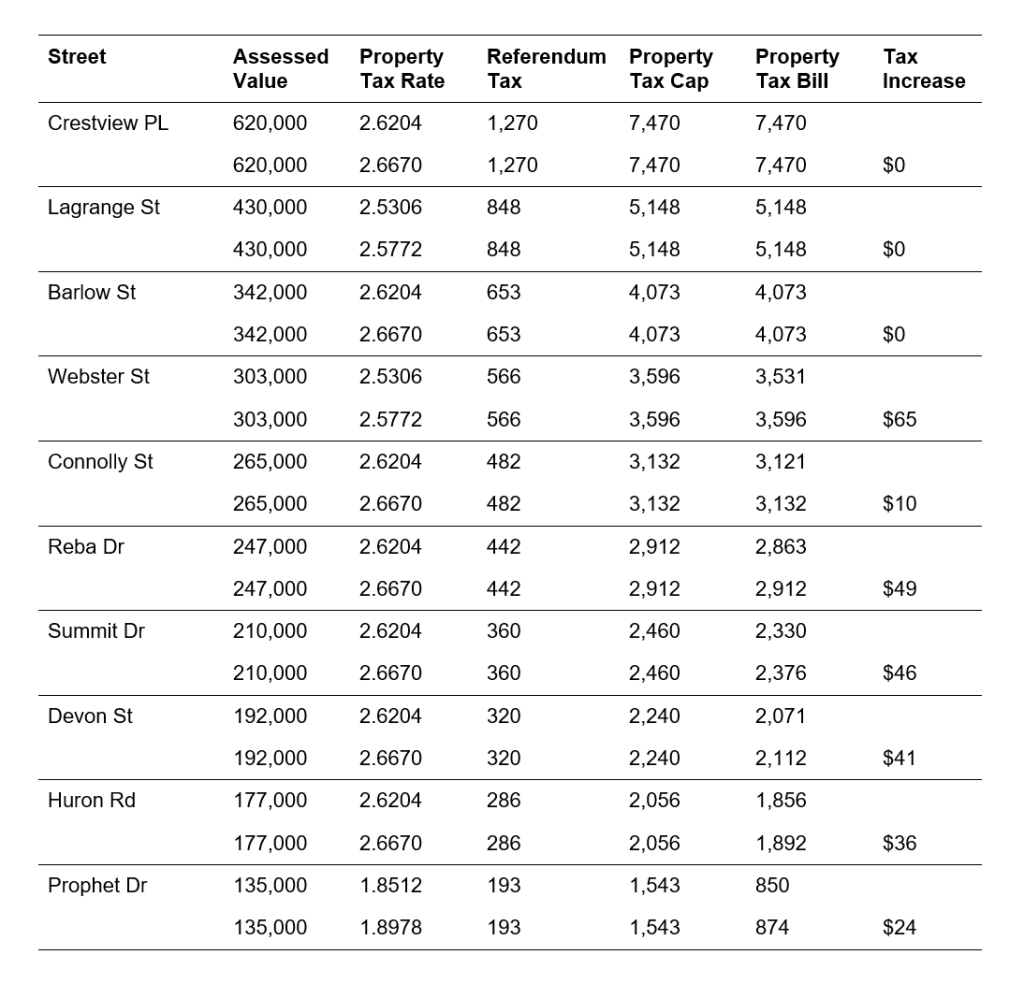
Wang questioned the accuracy of the $700,000 increased tax revenue estimate. He explained that multiplying the proposed debt service tax rate increase of 0.0466 per $100 of assessed value by the $1.278 billion in assessed value is less than the $700,000 estimate (it equals $595,000). We know that many homes are at the tax cap and so the increased tax rate will raise less than this.
Wang asked if Reuter was also including the money transferred from the operations fund to the debt service fund. Reuter said that there will be less money available in the operations fund and that referendum funds would be used for those expenses. Wang asked what would happen if our assessed value were to actually go down, perhaps because of a government reform. Reuter said that this would affect every local government entity and that he couldn’t speak to the specific effects on our school district.
3:37:16 Simonetto shared a presentation similar to what she shared at the August work session. Current bond payments for this year are about $6 million and increase each year to about $7 million. General obligation bonds are issued in the name of the school corporation with a limit to the amount that can be issued. General obligation bonding ability is tied to the assessed value of property in the school district. The maximum amount of general obligation bonds that our school district can issue is $8.5 million. The proposal is for a $6.2 million general obligation bond which would be paid back over 6 years. There is an upfront cost of $200,000 in issuance fees, paid out of the borrowed amount, and projected interest costs of $724,000 over the 6 years. Soon after issuing the bonds, the school corporation would use the $2.8 million remaining in the 2017 construction account (which the previous board restricted to only use for debt payments) to make a large one-time debt payment. This means that there would really be just $3.2 million in new funds available. Issuing this debt should increase the debt service tax rate back to the historical 0.5375 rate.
3:47:22 There were no comments from the audience for the GO Bond Preliminary Determination Hearing.
3:48:23 Cronk shared the finance update: July Financial Report – Funds, August Financial Report – Funds, Credit Card Statement, and Claims Docket Object Breakdown.
3:50:24 Greiner expressed appreciation to Mayor Erin Easter and Larry Oates for the potential partnership with the city for our tennis courts project. Oates agreed to substantial funding support for the renovations if we include pickleball striping for the community to use whenever the school is not using the courts. Greiner is working on a memorandum of understanding with the West Lafayette Schools Education Foundation as they begin fundraising for the JSHS ground floor projects. Greiner reported that he attended WLES and WLIS parent council meetings. He thanked all the families for their continued volunteer support which helps make WLCSC successful. Greiner noted that he had signed the school board candidate petition for Austin, who had asked him to sign it. He wanted to clarify that he would have signed the petition of any candidate running for school board, but she was the only candidate who asked him. He appreciates all those who are willing to serve.
3:53:56 Board Reports:
- Austin said she will attend the Hoosier Women Forward Luncheon with representative Chris Campbell.
- Schott shared that the WLSEF are hosting the alumni tailgate on September 20 prior to the home football game. The class of 1974 will be celebrating its 50th reunion that weekend. The scarlet and gray dinner and auction will be March 1, 2025.
- Marley said that the Redevelopment Commission had a first reading of the TIF district allocations. There are 7 TIF districts with $28.4 million dollars each year to use for capital projects in West Lafayette. They are planning to do a public safety center for about $60 million. They are also doing exploratory work on a new preK center.
- Yin shared appreciation for all the school board candidates running to serve and contribute to our school district. She said she did not ask Greiner to sign her candidate petition because she didn’t want him to feel uncomfortable, but she does believe that he would have signed her petition if she had asked.
- Witt shared that the band is dismissed from practice in complete darkness and so she would like field lighting added. There was no teacher discussion meeting in August because of lack of agenda items. She represents our region for the awards committee and delegate assembly of the Indiana School Board Association.
- Wang appreciates that Greiner is sending an update to staff to keep them informed. The parks and recreation after-school program is running well. They also have a preschool program. He shared that parks and recreation have their own foundation. They recently had to update their by-laws because the foundation is required to be controlled by their supported organization. The park and recreation board now appoints the majority of the board of directors for the foundation.
- Mumford shared that the Public Schools Foundation of Tippecanoe County (PSFTC) fundraiser cupcake run is September 22.
Location: Happy Hollow Building, LGI Room
Future Meetings (calendar link)
- Public Work Session – *Monday, October 7th at 5:00pm at Happy Hollow LGI Room
- Public School Board Regular Meeting – *Monday, October 7th at 6:00pm at Happy Hollow LGI Room
*DATE CHANGE: 1st Monday of October (2nd Monday is Fall Break)This document is my summary of the public school board meeting, not the official meeting minutes. My personal thoughts and opinions are given in italics and represent my own views which do not necessarily reflect those of any other member of the school board. I identify myself as Mumford in the summary but use first person when describing my personal thoughts and opinions. Previous agendas, minutes, and audio recordings can be found at the WLCSC website.
 Dacia Mumford