Key Takeaways: Our school district used to have an unwritten agreement with TSC that allowed the superintendent complete discretion to admit as many or as few transfer students as he wanted with no limits or checks to make sure admission decisions were applied equally. In this meeting, the board adopted a written transfer policy that imposes a limit on the number of transfer students and uses a lottery to decide which transfer applications will be accepted. Once a student is accepted as a transfer student, they are treated the same as resident students and are allowed to continue year to year (unless there are discipline or attendance issues) without risk of being turned away. The risk is concentrated at the point of entry, and the limit on the number of transfer students should encourage more families to move into the district.
Agenda with links to board documents
Topic Timestamps: YouTube Recording
- 0:00 WLIS update
- 11:22 Public comments
- 16:42 Approval of Consent Agenda
- 17:46 Approval of Wonderland Lease Renewal
- 18:22 Approval of Bond Counsel Service with Ice Miller for Referendum
- 32:45 Transfer Policy C125
- 55:08 Current Transfer Students in Policy C125
- 1:17:22 Capacity chart in Policy C125
- 1:23:11 Determining Capacity Limits in Policy C125
- 1:54:11 Capacity Limits in Policy C125
- 1:57:52 Returning to the issue of Current Transfer Students in Policy C125
- 2:39:56 Summer School Fees for Transfer Students in Policy C125
- 2:49:30 Revision Transfer Policy C125 Approved
- 2:50:10 Superintendent Update on Part-Time Enrollment Policy
- 2:52:34 CFO Report
- 2:55:36 Approval of Available Transfer Seats for the 2026-2027 School Year and Application Process
- 2:59:26 Board Reports
The following is my summary of the public school board meeting, not the official meeting minutes. My personal thoughts and opinions are given in italics and represent my own views which do not necessarily reflect those of any other member of the school board. I identify myself as Mumford in the summary but use first person when describing my personal thoughts and opinions.
0:00 – The regular meeting began with West Lafayette Intermediate School (WLIS) Principal Margaret Psarros presenting the WLIS update.
11:22 Communication from the Audience (those who had signed up before the meeting began). There was confusion during the meeting when a community member attempted to speak after signing up on a sheet that had been left out once the top page was removed. When the individual tried to explain, Austin stopped them and said public comment was only allowed at the beginning of the meeting. Austin has not enforced this practice consistently, and I saw the response as reflective of both a lack of community focused leadership and a selective use of flexibility when it served her interests.
- Randy Studt, JSHS German teacher, said he was embarrassed by the informal Google survey sent out about the transfer policy. He made it clear that he was speaking about a survey that Yin sent out, not the informal Google survey that the school district sent out earlier on the same issue. He criticized the school board for taking so long to set a transfer policy and urged the board to approve a transfer policy immediately so families could make decisions and the district could move forward with planning and recruitment. I agree that we should have set a transfer policy long ago. Our district never had a written transfer policy. The superintendent could admit or deny transfer students unilaterally with no constraints. I’ve asked for years that this be addressed. If it were not for the state legislature removing our ability to charge tuition to transfer students, the majority of the board would never have considered setting a policy.
- Wendi Ailor, executive director of the West Lafayette Schools Education Foundation, invited the community to attend the West Lafayette Schools Education Foundation’s Scarlet and Grey dinner and auction, describing it as the foundation’s largest annual fundraiser. She said the event supports work such as the backpack program, teacher grants, scholarships, and other efforts that benefit West Lafayette students and families.
16:42 Consent Agenda:
- Approval of the Agenda for the March 9, 2026 Regular Board Meeting of the
- Board of School Trustees
- Approval of the Minutes of the February 9, 2026 Regular Board Meeting of the
- Board of School Trustees
- Approval of the Minutes of the March 2, 2026 Work Session of the Board of
- School Trustees
- Field Trip: 5th Grade to Camp Tecumseh (May 4 – May 7, 2026)
- WLCSC Transportation and Indiana Band Agreement
Wonderland Annual Lease Renewal- Personnel Report
- Disposition of Checks
Austin motioned to remove the Wonderland Annual Lease Renewal the consent agenda to allow Purpura to abstain as he serves on the board.
Voted 7 out of 7
17:46 Wonderland Annual Lease Renewal: Voted 6-0-1, with Purpura abstaining
18:22 Bond Counsel Service with Ice Miller: Kristin McClellan from Ice Miller outlined the timeline and legal steps required if the board chooses to pursue a November 3, 2026 operating referendum. She said the most important deadline was noon on August 1 for certification, which meant the board would need to adopt a resolution by early June under the proposed schedule, with initial legal steps beginning in May. Mullen explained that the board and administration would need to determine key details including the purpose, length, maximum rate, and levy amount, while also working with the county auditor and the Department of Local Government Finance. She also noted that once the board adopts the final resolution to place the question on the ballot, restrictions would take effect on using school resources to promote the referendum.
Voted 7 out of 7
32:45 Policy C125 Admission to the Corporation (Legal Settlement): Discussion of the transfer policy began with the board voting 7-0 to remove both sections of red text on page 1. The board then discussed the final paragraph on page 2 regarding the eligibility of children of school employees if the employee no longer works for the district. Children of school employees are not considered transfer students and so this paragraph would require an application to become a transfer student the next year. Enrollment for the children of school employees is tied to their employment in contrast to transfer enrollment which is based on available capacity. The board voted 7-0 to keep this paragraph unchanged.
55:08 Current transfer students: The discussion moved to page 3 regarding transfer students who are currently enrolled and wish to continue in the district. Board members proposed 3 options: (1) current transfer students enrolled at the end of the year may continue the next year and could only be denied for disciplinary or attendance issues; (2) make reasonable efforts to allow currently transfer students to continue the next year if they apply on time, but with no guarantees; (3) use option 1 for current transfer students, but use option 2 for future transfer students.
Witt motioned to approve option 2 to not give current transfer students a guarantee. Yin said she agreed with Witt and noted that the feedback she had collected overwhelmingly supported option 2. Purpura noted that 7th grade already has more students than capacity and asked if option 2 would mean not allowing the transfer students in this grade to continue. Mumford noted that 10th grade is also over capacity and the same issue would likely apply. Witt said she was concerned about applying option 2 to students already enrolled and said she wanted those students to be treated as an exception rather than being affected by the change, suggesting that she actually supported option 3 rather than 2.
Lyle said option 2 did not require the district to remove current transfer students and only meant that continued enrollment was not guaranteed. Wang said the language in option 2 about making a reasonable effort was strong from a policy standpoint because it preserved the board’s intent while giving administrators and principals flexibility to handle capacity issues in day to day practice.
Mumford asked Greiner to explain what he would do if the board were to adopt option 2. Greiner said that his approach would be to let current transfer students remain because they were accepted when space was available. He said that if a grade later moved slightly over capacity, the district would not remove current transfer students but would close the grade to additional transfers.
Mumford said that options 1 and 2 are different and should not be thought of as being the same. Option 1 means no new students would be admitted once a grade was over capacity, but current transfer students can remain. Option 2 means current transfer students in an over-capacity grade would not be guaranteed continued enrollment.
Greiner said option 2 would give the district flexibility to keep or remove transfer students as long as being over capacity does not negatively affect learning. He said that the district could close a grade to new transfers and, if necessary, use a lottery to decide which of the current transfer students would be allowed to continue in our district. Yin said she agreed with option 2 and that the district should not promise continued enrollment. Mumford said option 2 creates a gray area for both the district and the families of transfer students. She argued the policy should be clear about what happens once a grade is over capacity.
Greiner said legal counsel advised that option 2 did not need to be included explicitly because the concept was already addressed elsewhere in the policy. Witt asked to amend her motion to approve option 2 to instead remove options 1, 2, and 3.
Purpura said that removing the section entirely would create ambiguity. He said that his view is that once the district admitted transfer students, it was making a commitment to them and that they should be allowed to continue. If a grade is at or over capacity, the district should stop accepting new transfer students into that grade.
Mumford said that removing this section entirely, without changing other sections, would mean that current transfer students in over-capacity grades would have to be subject to a lottery to determine which would be allowed to continue in our schools. The board cannot say it intends to keep all current transfer students and then adopt a policy that would prevent them from returning next year.
Yin said that option 3 would allow all our current transfer students to remain while not guaranteeing continued enrollment for future transfer students once capacity was reached. She said that she prefers option 2 because there should not be a transfer student guarantee. Roth pointed out that the board had not yet decided on capacity, which could help clarify the discussion. The board decided to return to the issue of current transfer students later in the meeting.
1:17:22 Capacity chart: Mumford proposed inserting a table showing capacity by grade in the policy (on pages 6 and 7) instead of including a link to the table on the school website. If the table were included in the policy, any change to the capacity numbers would require two board meetings. Witt moved to instead include a link to the capacity table in the policy to give the administration more flexibility to make changes efficiently. Lyle supported that approach, saying a link would keep the numbers visible without requiring a reading and a vote each time the capacity numbers needed to be adjusted. Mumford disagreed and said that grade-level capacity does not need to be adjusted often and should be included in the policy itself. The capacity numbers determine how many transfer seats are available and affect class sizes. Mumford said that any change should go through the regular process to ensure the community is informed.
Voted 6 out of 7 (Mumford opposed to not including capacity numbers in the policy)
1:23:11 Determining Capacity Limits: There are three proposed options for defining capacity: by grade level, by grade level with a total district capacity cap, or by grade level with a total district capacity cap and a total transfer student cap. The administration had originally proposed the option by grade level capacity only, but Witt said the administration had now recommended also including a total district capacity cap that is lower than the sum of the grade-level capacity numbers. Witt moved to adopt the option with a total district capacity cap. Yin said she proposed the option that also includes a transfer student cap because without a cap on the total number of transfer students, the district could continue to add transfer students if there is a decline in resident enrollment. Witt said she supports what the administrators proposed because they are responsible for carrying out the policy. She said she trusted the judgment of the administrators.
Mumford proposed setting the transfer student cap as a percentage rather than a fixed number, saying this approach would help prevent the district from becoming a commuter school. She proposed setting the transfer cap at 7 percent of total enrollment, which would be 162 students based on current enrollment (the school district currently has 155 transfer students). Making the transfer student cap a percentage would encourage the administration to increase resident enrollment, since higher resident numbers would allow for a larger number of transfer students up to the district capacity limit.
Yin said that without a total transfer cap families with children in low-enrollment grades could move out of the district and return as transfer students without affecting grade level or overall district limits. She argued that this would make it too easy for families in those grades to leave the district while still keeping access to the schools.
Voted 3 out of 7 (Austin, Lyle, Purpura, and Witt opposed 7% total transfer cap)
Voted 3 out of 7 (Austin, Lyle, Purpura, and Witt opposed any total transfer limit)
The motion to impose both grade-level capacity limits and a total district capacity limit that is less than the sum of the grade-level capacities passed.
Voted 6 out of 7 (Yin opposed)
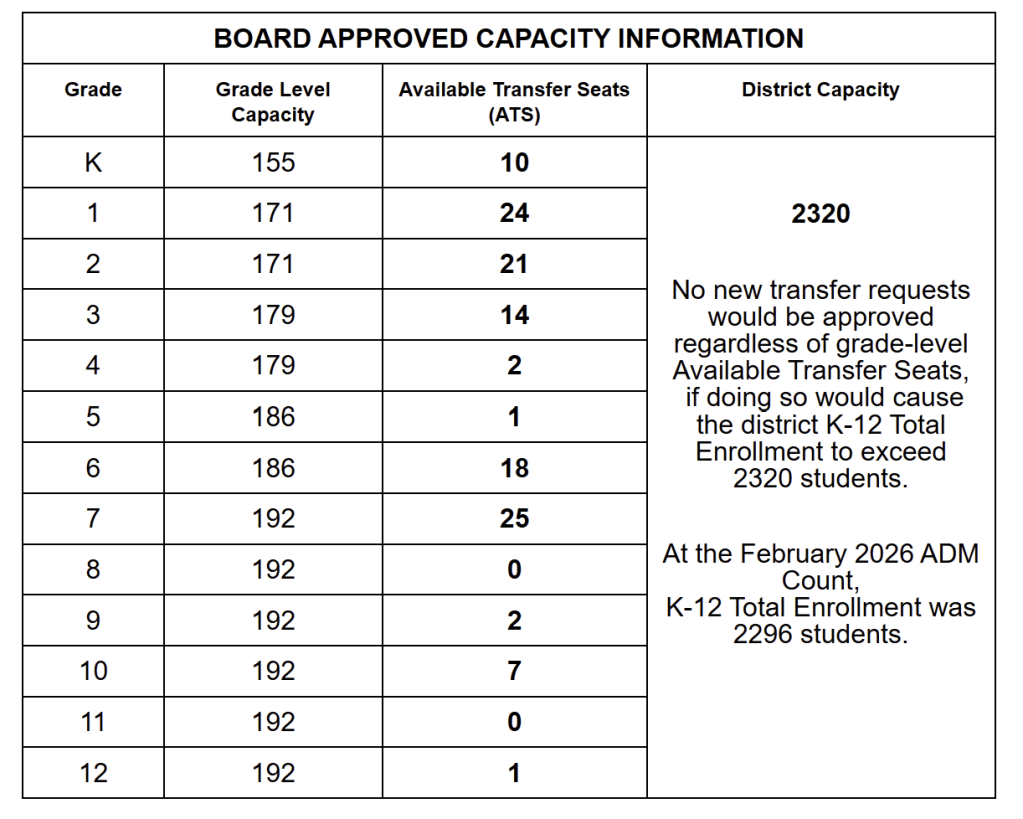
1:54:21 Capacity limits: Witt moved to approve the capacity for each grade level and district as proposed by the administration, including the paragraph stating that the capacity table would be available on the WLCSC website with a link. Because the total district capacity is lower than the sum of the grade-level capacities, the administration proposal also includes a requirement to accept transfer applications for Kindergarten first and then for each subsequent grade level (1st, 2nd, etc.) until the district capacity is reached. Transfer students would only be admitted up to the total district enrollment cap of 2,320. Mumford said that the administration had originally proposed higher grade-level capacity numbers with no district-level cap and so she had proposed lower grade-level capacity numbers. However, now that the administration had proposed lower capacity numbers with the district-level cap, she said she was comfortable with the administration’s recommended numbers.
Voted 7 out of 7
1:57:52 Returning to the issue of Current Transfer Students: The board returned to the discussion if current transfer students should be allowed to continue (option 1) or if they should have to reapply each year (option 2). Witt made a motion to approve option 2 where the corporation would make reasonable efforts, but no guarantee, to allow currently enrolled transfer students to continue.
Mumford asked if approving option 2 would mean that some current transfer students in 7th and 10th grades would not be allowed to continue the following year. Greiner said that under option 2, the district could but would not be required to turn away current transfer students, but would definitely close those grades to new transfer students. Mumford said that option 1 requires the district not turn away current transfers students while option 2 creates a gray area around what would happen when a grade is over capacity. She argued our policy should clearly state when transfer students are allowed to remain and when they are not, rather than leaving that decision up to administrator’s judgement each year because it causes stress and uncertainty for those students and their families.
Purpura agreed, saying that option 1 and option 2 were meaningfully different because option 2 left too much gray area about whether transfer students could stay when a grade was over capacity. He argued the policy should make the rule clear for families. He said that he prefers option 1 because any future changes would have to be made transparently through the board’s policy process.
Mumford said that most of what we heard from the community was consistent with allowing current transfer students to continue in our schools. That is what option 1 says. There will be uncertainty about students being able to transfer into our district in the future, but the policy needs to be clear about if transfer students can continue rather than relying on case by case judgment. Yin said that the emails she received were in favor of option 2 because residents and taxpayers do not want the district to overpromise continued enrollment. Transfer students who are accepted should still be subject to capacity limits in later years.
Witt changed her mind and moved to approve option 1 instead of option 2, saying that either is fine with legal counsel and either would be able to accomplish the goal and allow current transfer students to stay. Mumford said that the message she heard was a desire to let current transfer students remain, while not guaranteeing that new transfer applications will be accepted. She argued that approving option 2 and then adjusting grade-level capacity numbers each year to be able to keep current transfer students would undercut the purpose of setting consistent capacity limits. She said she wants the policy to be clear and argued that if the board does not want current transfer students to remain, then the policy should say that explicitly.
Purpura said that options 1 and 2 were being discussed by some as if they were the same, even though they would lead to different results. He noted that option 2 could subject current transfer students to a lottery each year, while option 1 made it clear that transfer students are allowed to continue unless future board action changes the policy. He argued that option 1 was preferable because it avoided the gray area he saw in option two.
Yin motioned to remove the whole section (options 1, 2, and 3).
Voted 2 out of 7 (Austin, Lyle, Mumford, Purpura, and Witt opposed removing the entire continuing transfer student section)
Austin recommended talking about option 3. Wang motioned to approve option 3, under which current students would be exempt, while future transfer students would face uncertainty if the district or grade level was at capacity. Mumford said that she believes that out-of-district families should face uncertainty at the point of entry into our schools. Resident families pay higher taxes and higher housing costs and reasonably expect that they will receive priority in our schools. Once we have accepted a transfer student, they are our student and their mental health and stability is important. If the district admits a transfer student, that student should be able to continue building friendships, connections, and continuity in school rather than face year-to-year uncertainty. She said the transfer policy already creates risk for out-of-district families by imposing lower capacity limits and a district cap, and she said that she does not support adding more instability after those students have already been admitted. The board voted on adopting option 1.
Voted 5 out of 7 (Wang and Yin opposed option 1)
Voted 6 out of 7 (Yin opposed the deletion of item one on page 7)
Voted 7 out of 7 to approve the recommended red changes on page 8
2:39:56 Summer school fees may be paid by transfer students: There are two options for summer school participation by nonresident students. Option one would allow nonresident students to attend and be charged a fee, while option two would allow them to attend without that fee language. Witt said she had concerns about applying that approach broadly and thought charging nonresident students to attend summer school could make sense at the junior high and high school levels, but not for K through 6 remediation programs. Lyle said the district should keep the option to charge a fee while also reserving the ability to waive it for students who receive free or reduced meals. Greiner said remediation in the primary grades is mandatory and funded by the state, so there would be no reason to charge a fee in those cases. Roth added that if the district chose to charge a fee, the board would need to approve those fees.
Voted 7 out of 7 to approve the option to charge non-resident students for summer school
2:49:38 Voted 6 out of 7 to approve the revised transfer policy C125. This is a major step forward for the community in prioritizing resident students and creating a clearer, more transparent policy. In the past, being able to transfer into the district depended on our district’s unwritten agreement with TSC that allowed transfer students on a case by case basis . Under the previous superintendent, the process was inconsistent and raised concerns about discrimination. Under the current superintendent, the number of transfer students increased rapidly, more than doubling in just 3 years.
This new policy allows the district to accept a small number of transfer students to help balance grade levels, but it sets limits and creates a more open and consistent process. It also adds meaningful risk to being accepted as a transfer student and creates more accountability.
2:50:10 Superintendent Report: Greiner said that the issue of part-time student enrollment for resident families had recently been raised. He explained that the district does not currently offer part-time enrollment and does not have a policy on the matter, but said that interest in the topic suggests the board policy committee should review the issue and decide whether a formal policy ought to be developed. Mumford noted that a community member had pointed out that the district already has a policy in place, identified as Policy 9270. She asked whether CCHA was recommending a change to that policy. Greiner clarified that the existing policy is set to be rescinded and said it currently gives the superintendent authority over part-time enrollment. He added that he supports the high school principal’s current practice of not allowing part-time student enrollment. Greiner said that because CCHA does not have a policy, the board would need to move one forward on its own if it wanted to adopt one.
2:52:34 CFO Report
2:55:36 Available Transfer Seats: Mumford said that the newly adopted transfer policy, C125, requires the board to approve the available transfer seats before applications could be opened. Greiner proposed the following table which shows 125 available seats with 8th and 11th grades closed. However, the available transfer seats for the district is less because district-level capacity of 2,320 minus the ADM count of 2,296 students means there are only 24 available transfer seats which will likely be filled primarily in the younger grades.
Voted 7 out of 7
The transfer application information has been added to the school corporation’s website. State law requires priority to be given to siblings of current transfer students, so the probability of a transfer application being accepted by grade is not yet clear.
I appreciated Austin’s professionalism in leading this meeting. She made space for everyone to be heard and allowed questions to be asked.
2:59:26 Board Reports
3:10:39 The meeting was adjourned
Upcoming Public Meetings in the Central Office Board Room, located at 3061 Benton Street:
- Regular Board Meeting: April 13, 2026 at 6pm
This document is my summary of the public school board meeting, not the official meeting minutes. My personal thoughts and opinions are given in italics and represent my own views which do not necessarily reflect those of any other member of the school board. I identify myself as Mumford in the summary but use first person when describing my personal thoughts and opinions. Previous agendas, minutes, and audio recordings can be found at the WLCSC website.
 Dacia Mumford